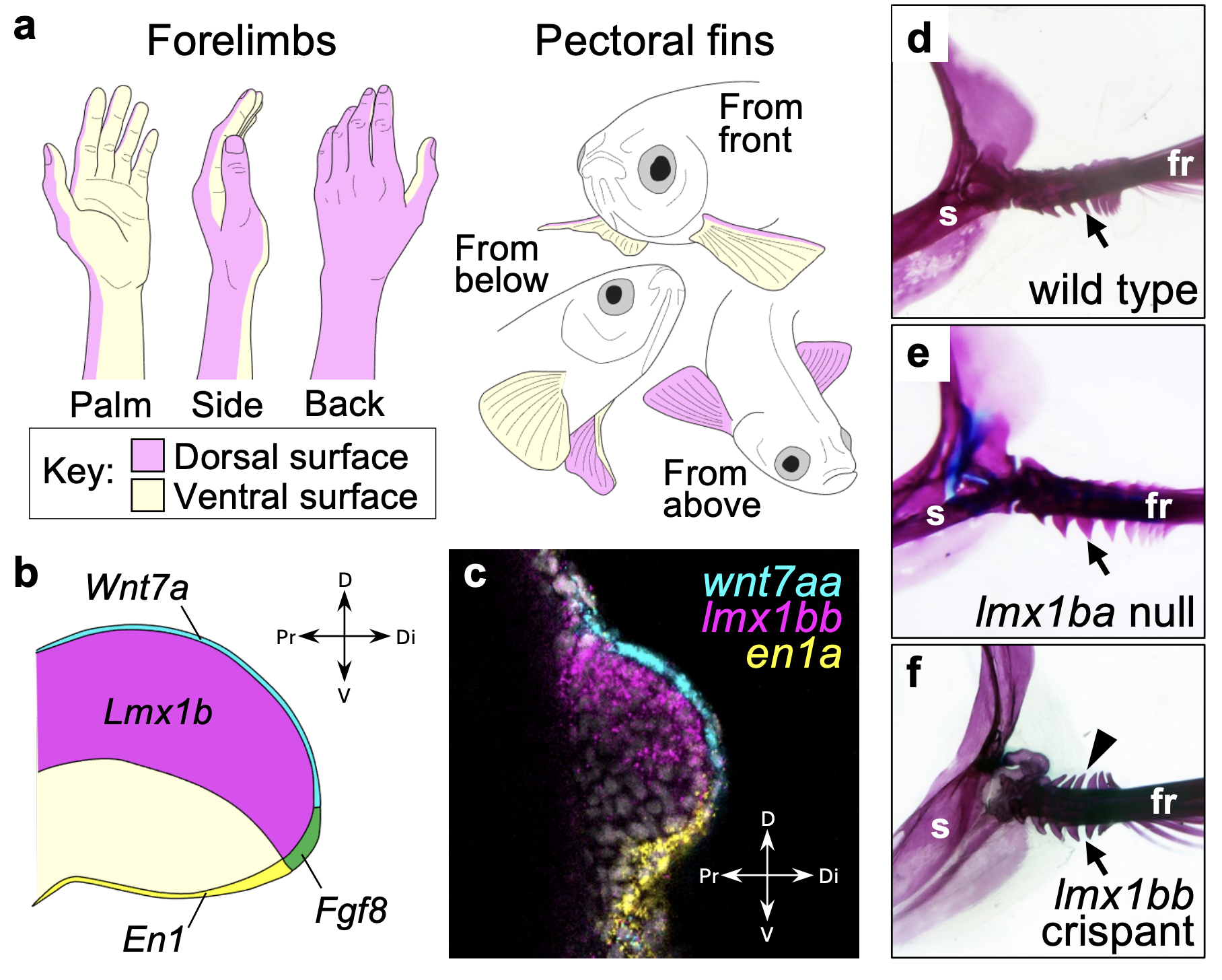
Limb function requires polarized anatomy across the dorsal-ventral axis, but it is unclear when the capacity for differentiation along this axis in paired appendages arose during vertebrate evolution. Here, we define ancestral dorsoventral patterning programs in the fins of fishes. We show that an ortholog of the limb dorsal determinant, Lmx1b, is required to establish dorsality in zebrafish pectoral fins and is activated by a conserved jawed vertebrate cis-regulatory hub. However, this hub is not essential for lmx1bb expression in median fins, suggesting that this control is an evolutionary innovation specific to the paired appendages. Although we find that the regulatory hub is highly conserved across gnathostomes, we identify a specific alteration of this region in hillstream loaches, fishes that naturally parallel the “double-ventral” fin phenotypes observed in zebrafish lmx1bb regulatory mutants. Altogether, our findings indicate that specific regulation of dorsal identity is an ancestral feature of paired appendage development that provided a prepattern for limb evolution and lineage diversification.
The origin and evolution of dorsal determination mechanisms in vertebrate paired appendages
Hawkins MB, Zdral S, Naranjo S, Julia M, Sanchez-Martin M, Daane JM, Cumplido N, Jandzik D, Medeiros DM, McMenamin S, Harris MP, Tena JJ, Ros M
2026.
Current Biology doi:10.1016/j.cub.2026.05.046.